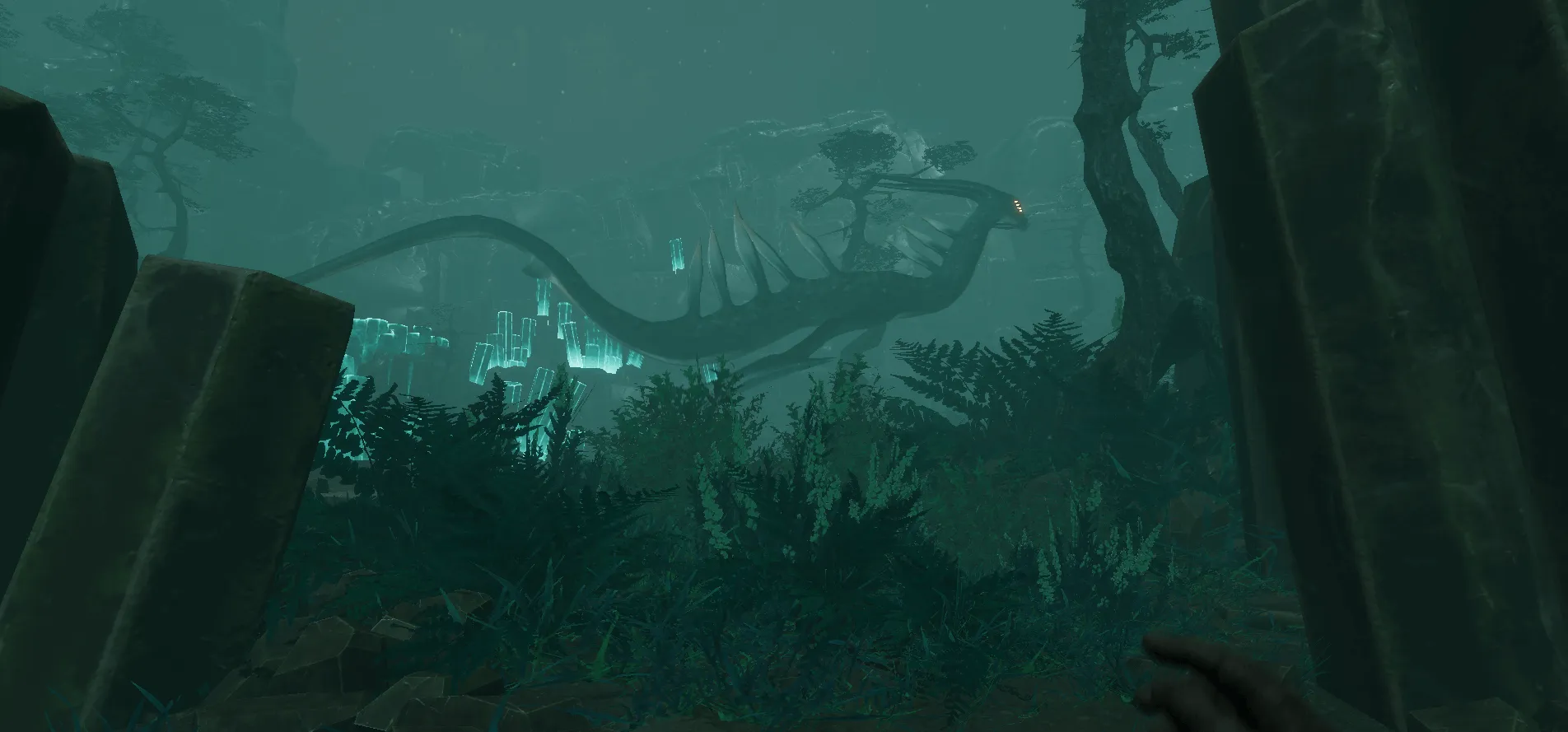
Summary
Designed to create a cinematic, intuitive, and emotionally responsive stealth experience.
- Adaptive Creature AI shapes pacing and encounter cadence
- Encounters shift from observation to tension,following a controlled emotional curve
- Sight lines are shaped with fog, curves, and lighting to guide player focus
- Environmental storytelling replaces UI, using visual anchors and narrative pathing
- Motivated movement through risk-reward stealth, secrets,and story-driven objectives
- Fail states teach consequences without breaking immersion
- Emergent tutorialization teaches mechanics through spatial layout and natural progression
General Information
My Tasks: Level Design, Game Design, Project Management
USP: Fractures changing the World, by a mythical creature
Team Size: 6
Target Group: Casual Stealth Gamers
Genre: Stealth, Adventure
Setting: During the night of Solstice
Engine: Unity 2023
Level Iteration Comparison
Key Info
Solstice is a 3D First-Person stealth survival game and has a playtime of roughly 20 minutes. The game was made in Unity with an HDRP with cross-platform assets. I worked on "Solstice" as a Level/Game Designer, Project Manager, and supportive Programmer. This project was realized as a University Project with a team of 5 other students in 13 weeks.
Stealth Driven Gameplay
In this project, I created immersive, atmospheric levels that enhanced the stealth-driven gameplay. My focus was on guiding players naturally through each level using lighting, environmental cues, and a “Guiding Light” mechanic, allowing players to find their way intuitively without explicit markers.
Level 0 - Game Introduction
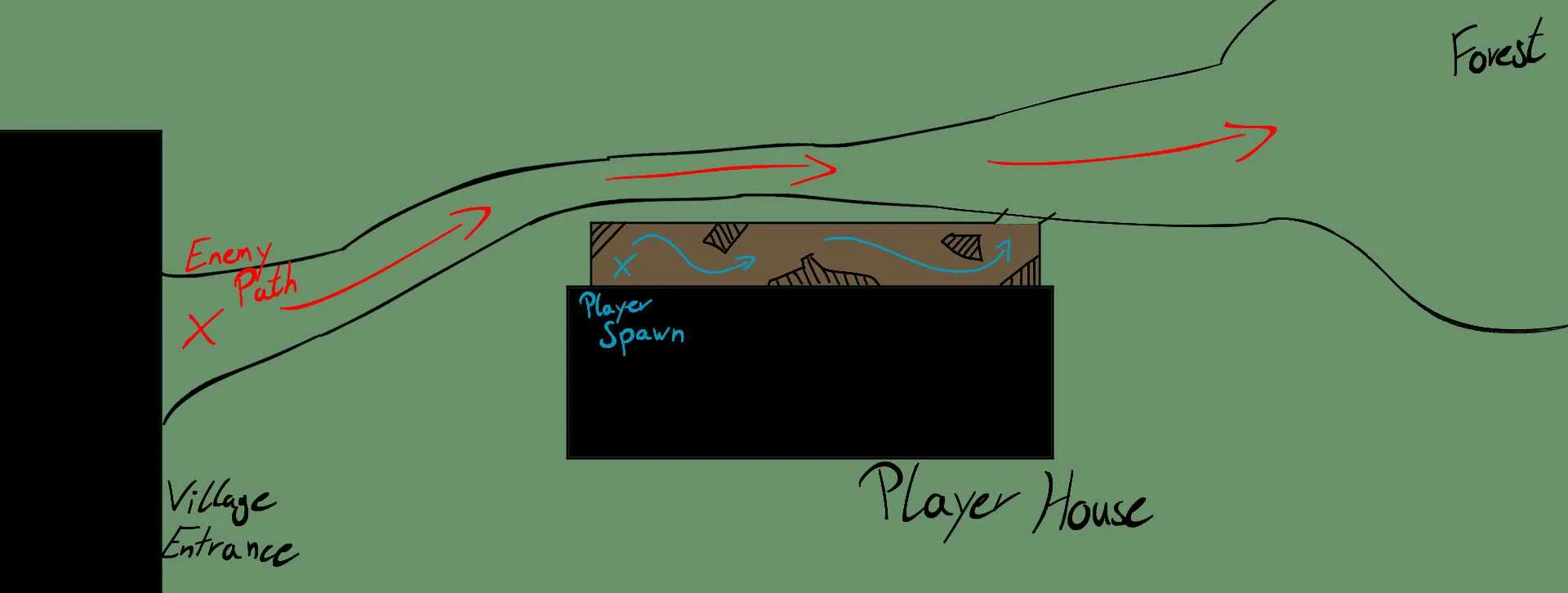
Gameplay Elements
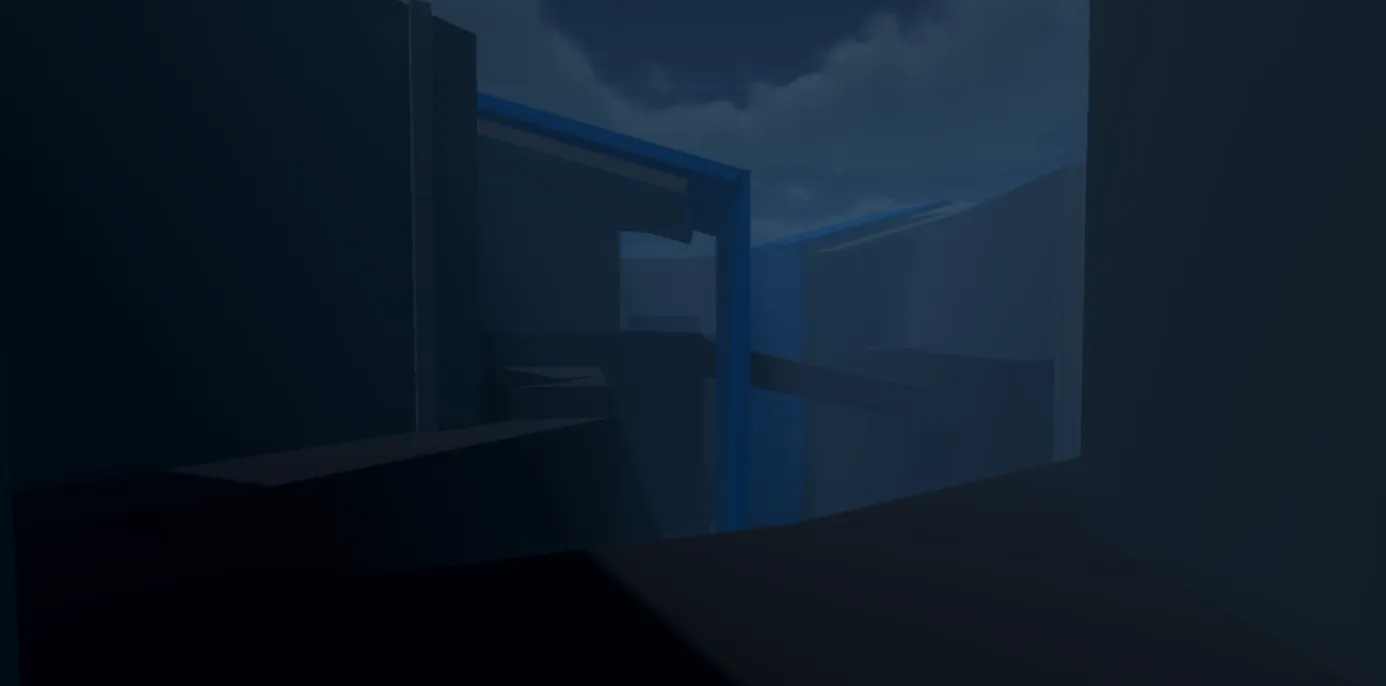
The level begins with the player positioned on a dimly lit balcony, where a single candle serves as the only light source. The first sight is of twoGuardians walking into the forest, setting the stage for a narrative-driventutorial. No UI prompts are needed, players intuitively learn coremechanics like movement and vaulting through environmental cues alone.
The broken railing, subtly highlighted by the candlelight, becomes the obvious interactive element, the first vaultable object, teaching the player to interact with the world through layout and lighting, not explicit instruction. This mirrors the character’s obsession with following the Guardians and aligns gameplay motivation with narrative intent.
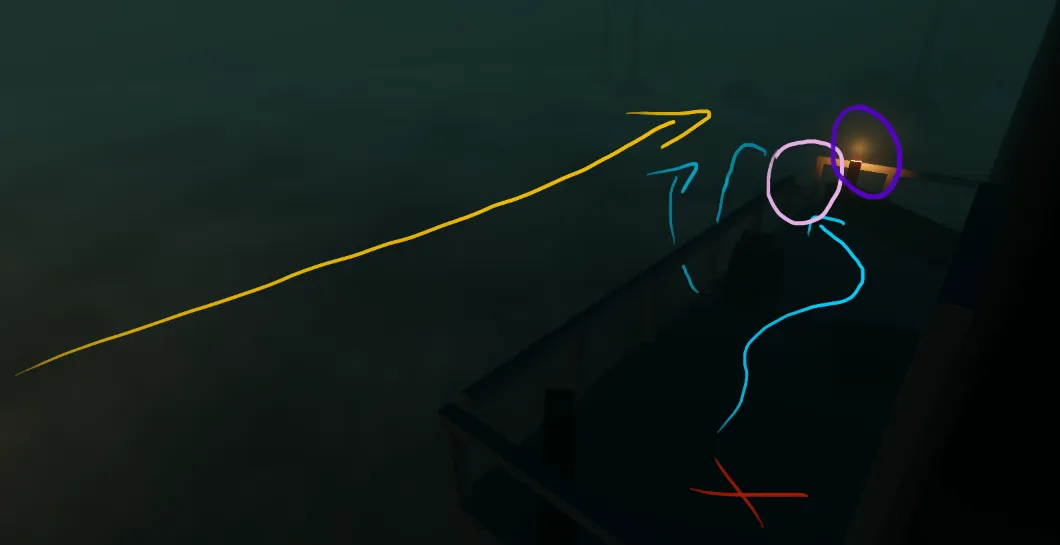
Level Flow
This spaceuses natural directionality based on Western left-to-right reading patterns: the player starts on the left, the Guardians move right,and the broken railing leads forward. The cluttered props, angled shapes, and moving NPCs all subtly push the player’s attention to the right, guiding them forward in a non-verbal tutorial.
Each design element, the light, the guardians' movement, and the broken railing, works in concert to build flow and maintain immersion,without breaking the fourth wall.
Level Goals & Visual Communication
This introductory space serves to seamlessly teach controls, establish player motivation, and introduce visual language that continues throughout the level. The environmental storytelling, shaped through motion,light, and form, ensures that players feel emotionally synced with the character’s goal.
Level 1 - Getting lost in the Forest
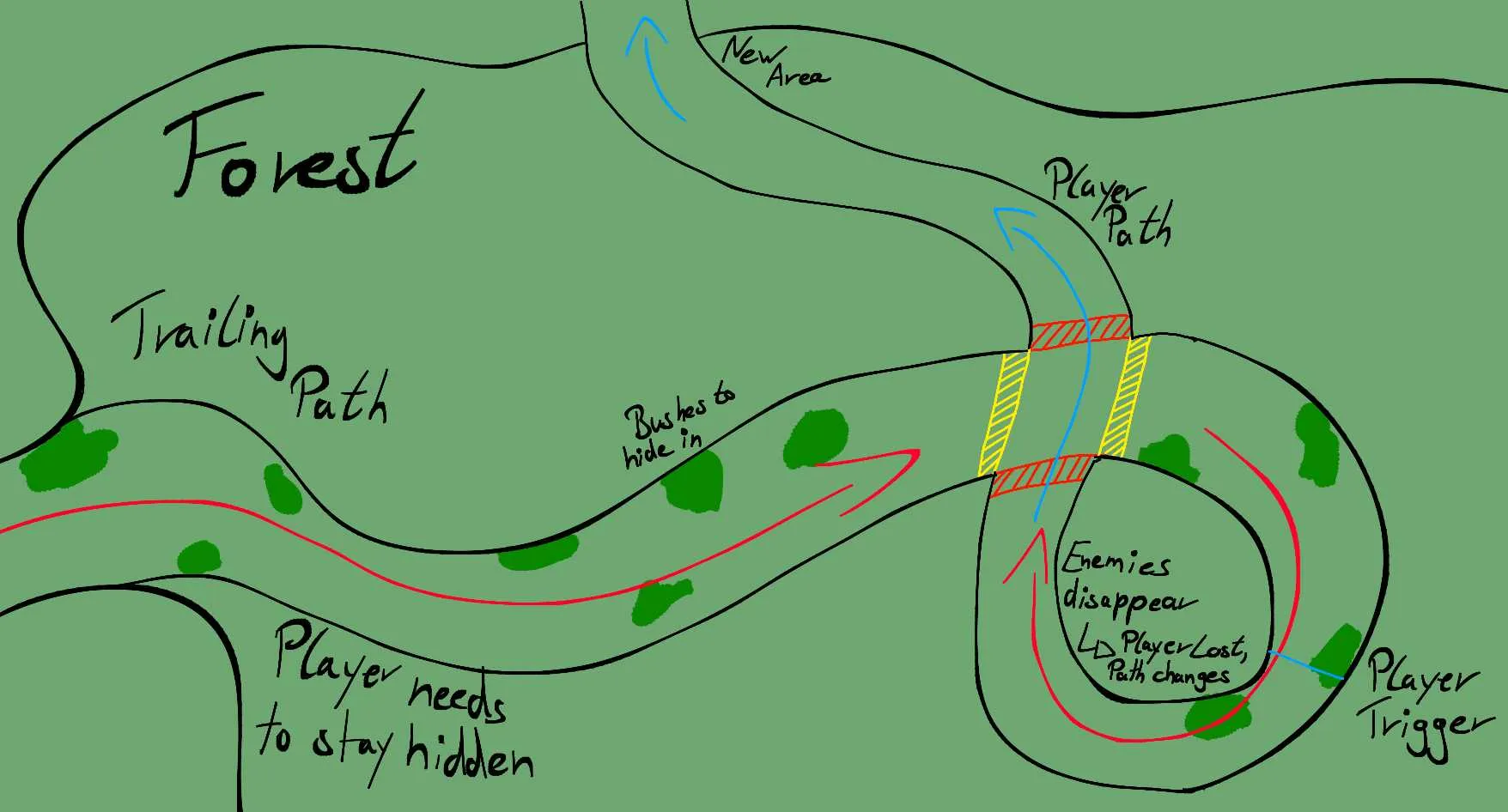
Gameplay Elements
In this level, the player is tasked with stealthily following two Guardians into a foggy forest during a forbidden Solstice event. The Guardians are the only source of light, making them the player’s primary visual anchor. This is a trailing mission, if the player gets too close or is spotted, the Guardians will confront the player, resulting in a restart.
The level encourages careful observation and strategic pacing, teaching players to balance curiosity and caution.
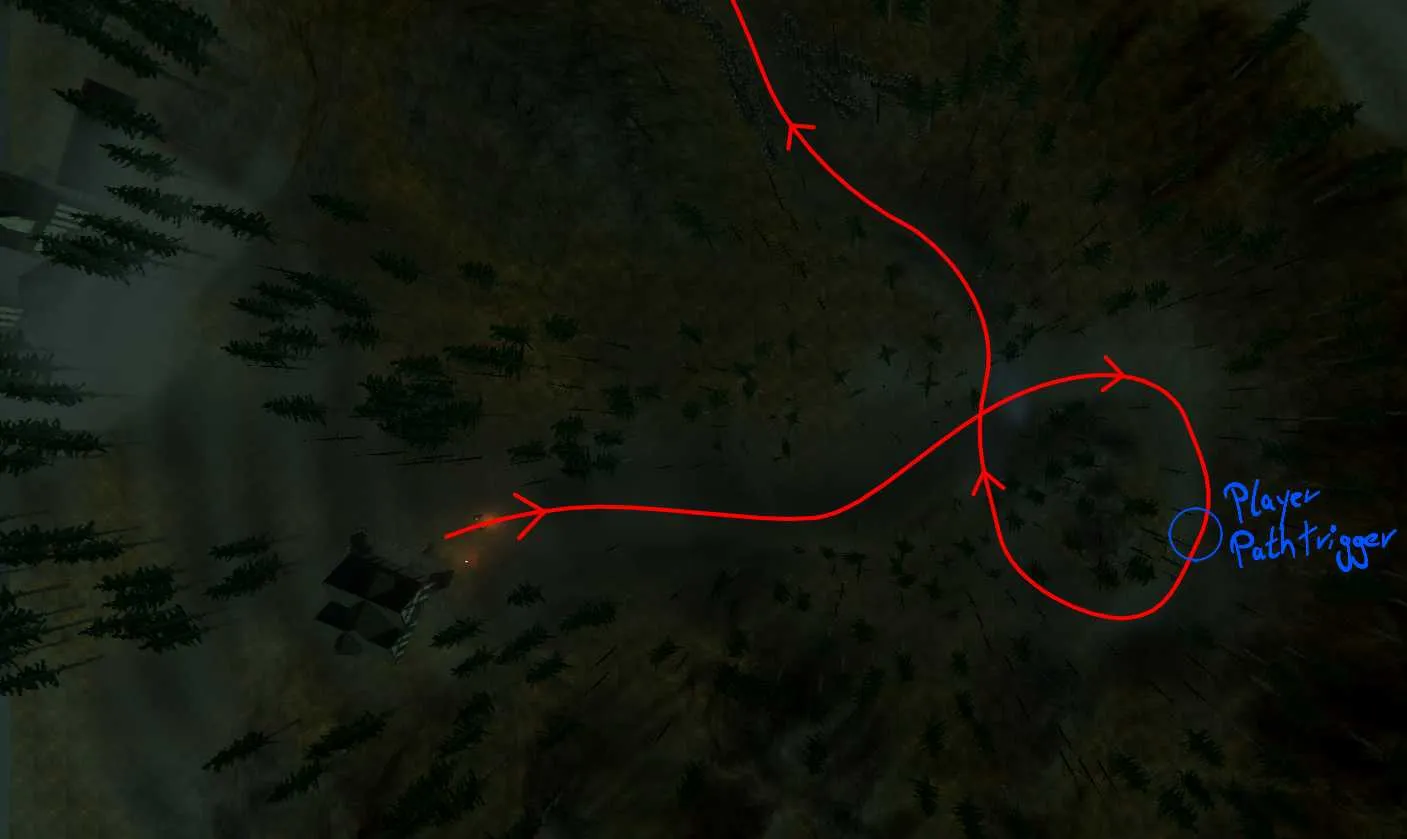
Level Flow
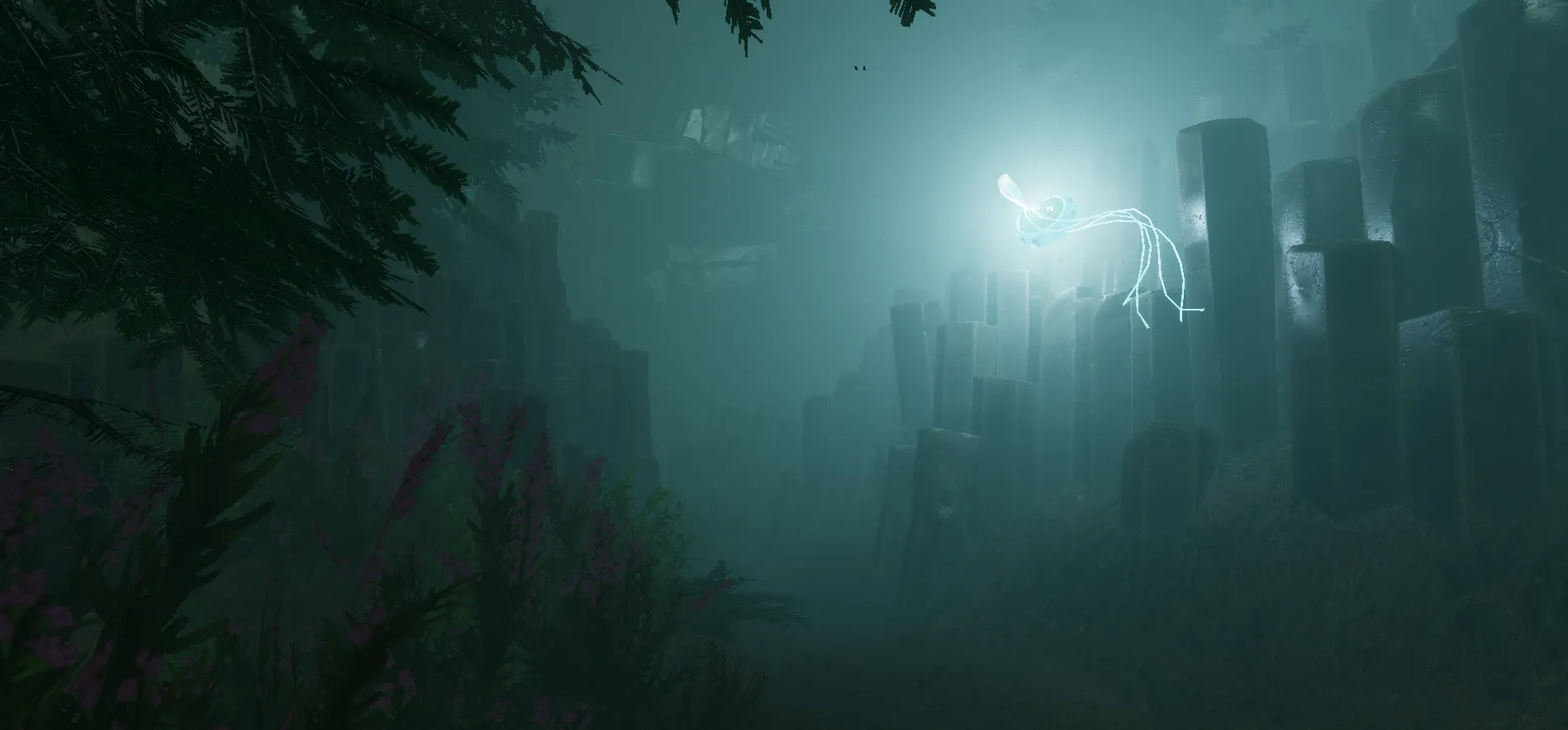
The path through the forest is designed as a curving trail, which the player initially thinks they’ve partially traversed, but it subtly shifts and evolves, creating a sense of disorientation. As the Guardians disappear into the fog, the sense of direction fades.
To replace them as a guiding element, small glowing blue creatures appear, gently flying along the intended path. These creatures serve as the new navigational tool, replacing the Guardians' light while maintaining the dreamlike pacing and mystical atmosphere.
Additionally,the Guardians' walk cycle pauses if the player falls behind, ensuring the player doesn’t get lost or disconnected from the narrative flow. This smart pacing mechanic keeps tension without frustration.
Level Goals & Emotional Framing
This level aims to heighten tension and curiosity by removing the safety of the familiar (the Guardians' light) and introducing the unknown (the blue creatures). It reinforces the idea that the player is not supposed to be here, aligning the emotional tone with the narrative stakes.
The foggy forest, with its dim blue lighting, supports a mysterious and atmospheric mood, immersing the player in a space where light, motion,and stealth drive both story and gameplay. The player’s goal is not only to follow, but also to observe and survive unseen.
Level 2 - Creature Introduction
Gameplay Elements
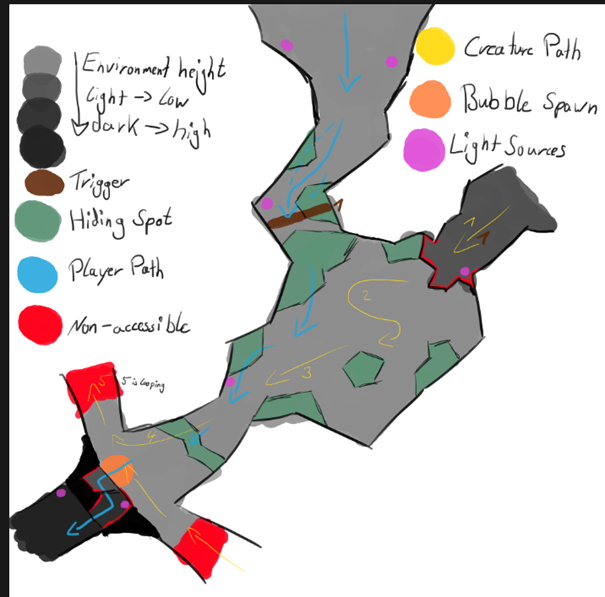
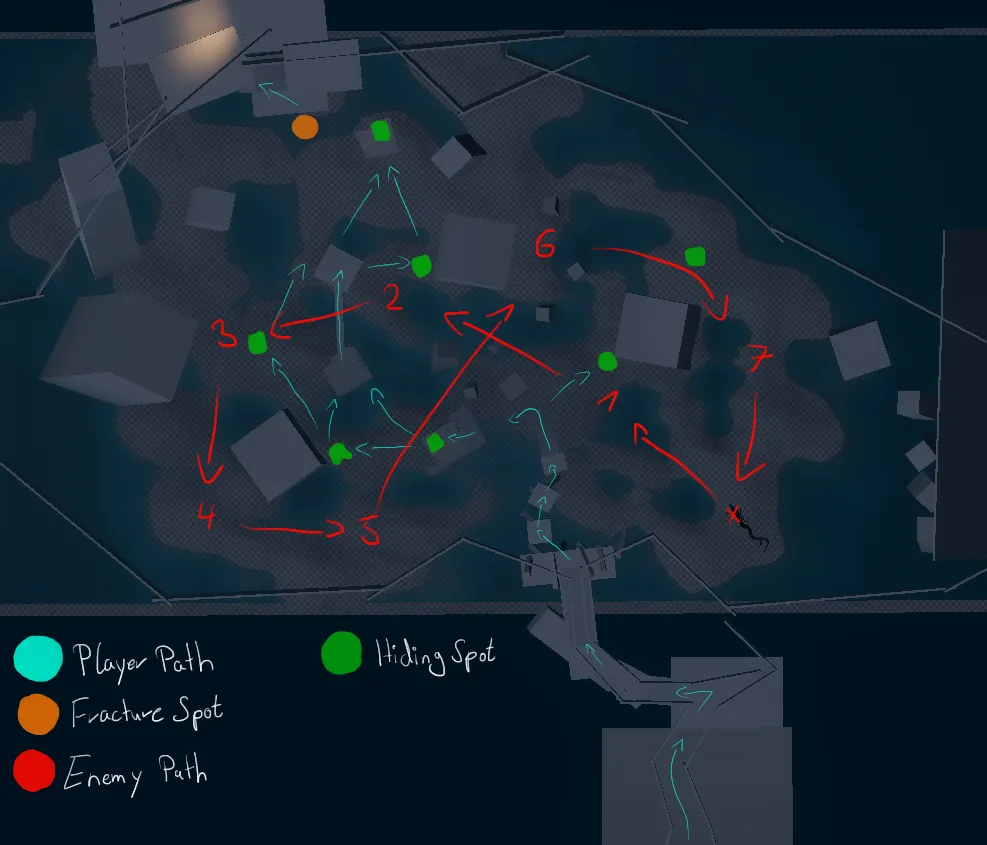
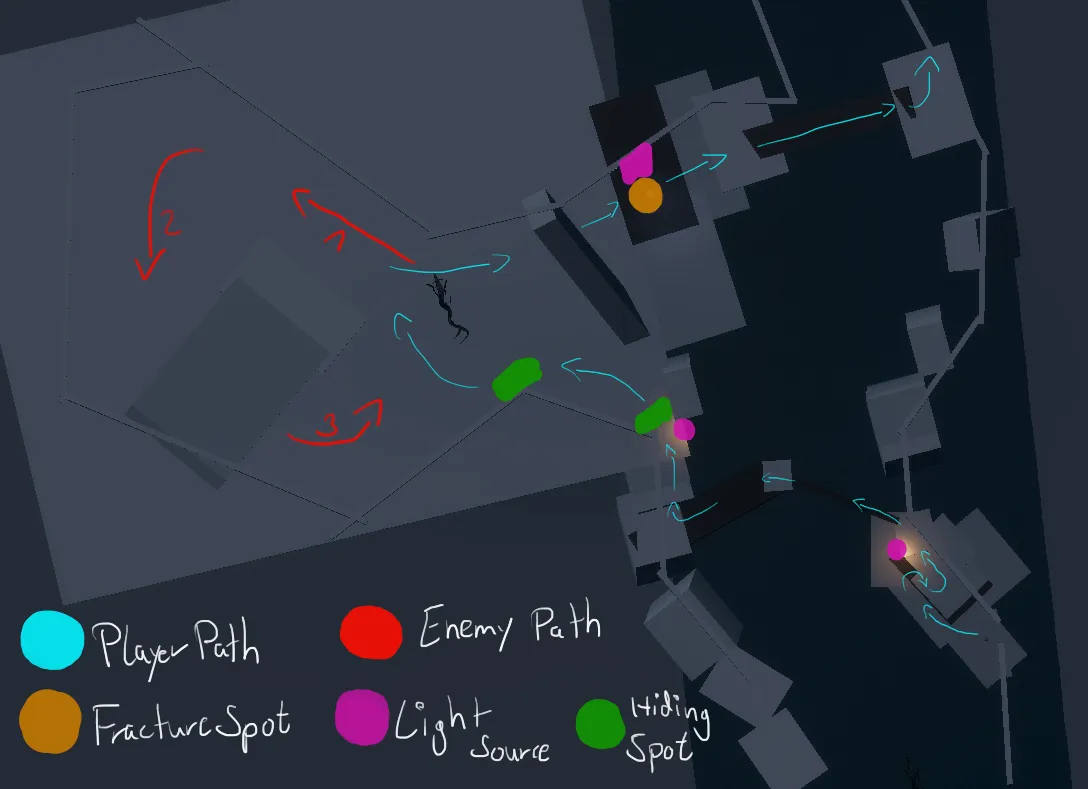
The level opens with the player positioned on a high vantage point, immediately met by two offset light sources that illuminate the path forward. These lights are placed at different elevations to enhance terrain naturalism and avoid artificial symmetry. They function not only as navigational guides, but also as tools of environmental storytelling, encouraging the player to explore beyond the critical path.
Early in the level, players discover optional hiding spots. These aren’t essential to progression but are intentionally placed to offer a "safe sandbox"—a space to experiment with stealth mechanics in a low-stakes environment. This serves as a "playground phase", where players are given freedom to engage with core tools at their own pace.
Later, a secondary light cue subtly nudges the player toward a larger hiding area,whether or not they explored earlier ones. This area becomes the emotional anchor of the scene.
Level Flow
This larger hiding spot sets the stage for a scripted creature introduction.Carefully timed, the creature appears only once the player feels safe,creating a powerful contrast between comfort and sudden tension. Entering from the top-left corner, a direction that naturally draws the eye in Western visual culture, the creature follows an S-shaped patrol route: first approaching the player, then retreating, subtly inviting pursuit.
Gameplay Elements
Creature Mechanics Introduction: The player is first introduced to the creature's core mechanic, it leaves behind "bubbles" that alter world physics. These bubbles serve as portals or distortions, changing how the player interacts with the environment (e.g., floating, jumping, or bridging gaps).
Safe Learning Environment:Early on, the design avoids high-risk situations. Players are encouraged to observe the creature from a distance, especially from a higher vantage point,which reduces tension and allows focus on understanding the mechanics.
Stealth Systems: The game slowly introduces crouching, hiding, and line-of-sight mechanics using bushes, vignetting effects, and circular patrol paths. These elements make the player feel secure while learning.
Level 3 - Stealth Introduction
Level Flow
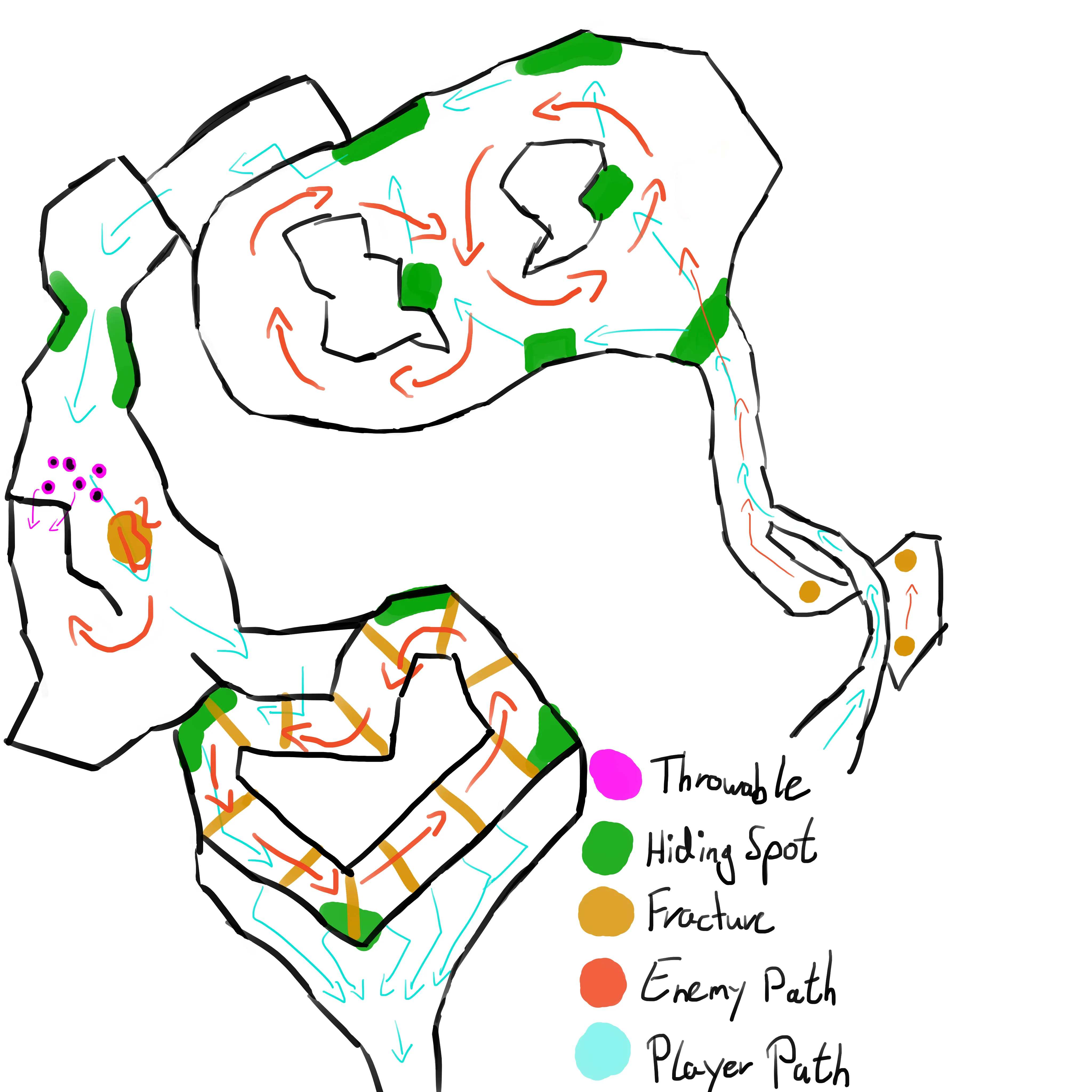
A nearby cliff-sidelight source enhances visibility and draws attention to the creature’s silhouette, reinforcing its narrative weight. The surrounding open area includes multiple hiding zones, which clearly show how line of sight works in stealth: players remain undetected when hidden, reinforcing the rules of engagement visually and intuitively.
As the creature continues on its patrol, it leads to a fracture spot, a dynamic environmental feature that opens and closes in sync with the creature’s route, tying movement and environmental design together.
Distraction Mechanics: Players later gain access to throwable crystals, which can be used to distract the creature. These are visually highlighted with outline shaders, ensuring intuitive interaction.
Environmental Teaching:Environmental “windows” and line-of-sight design subtly show the player where and how to use new tools like the throwable crystals, reinforcing mechanics without text-based tutorials.
Level Flow
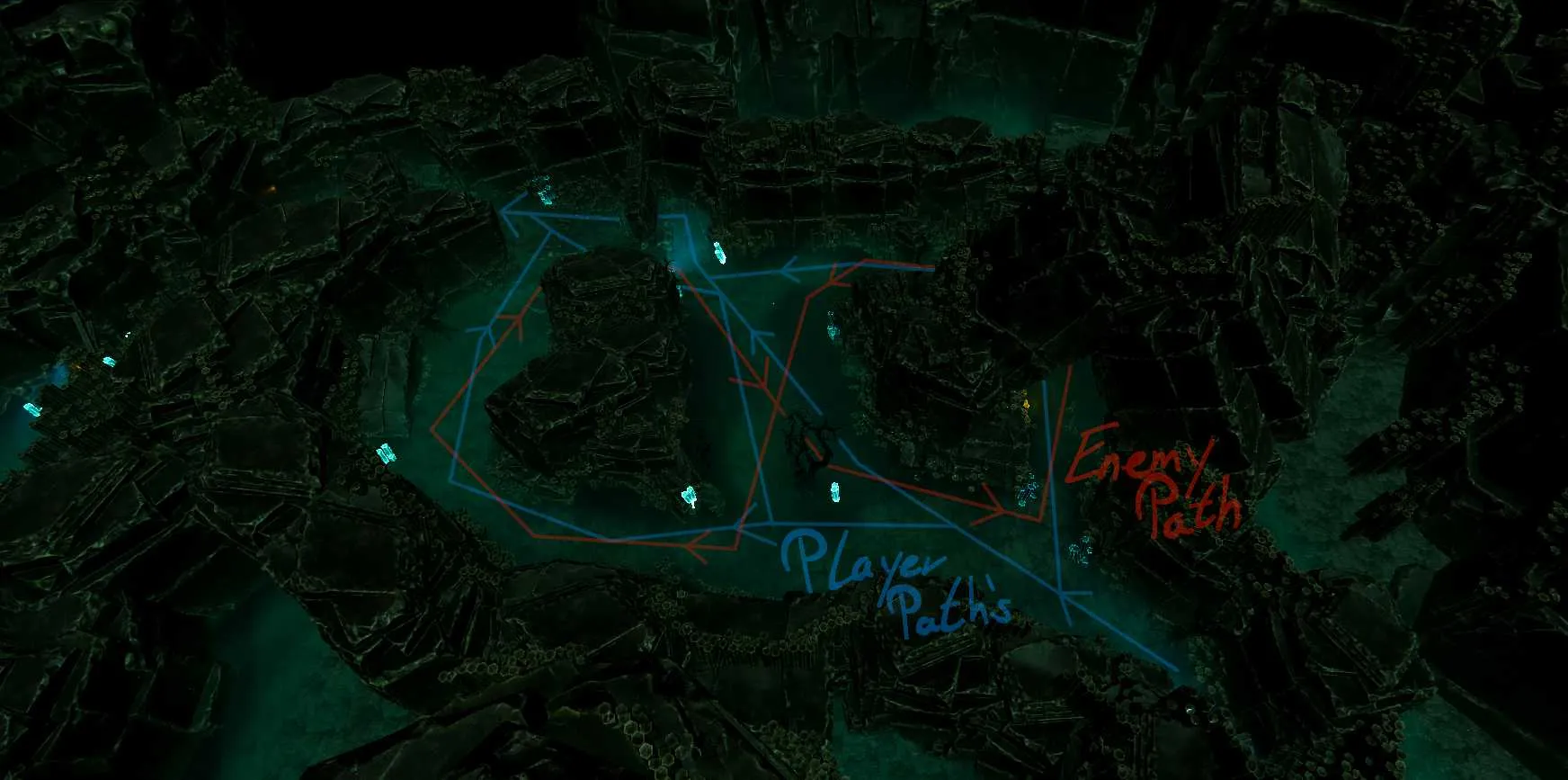
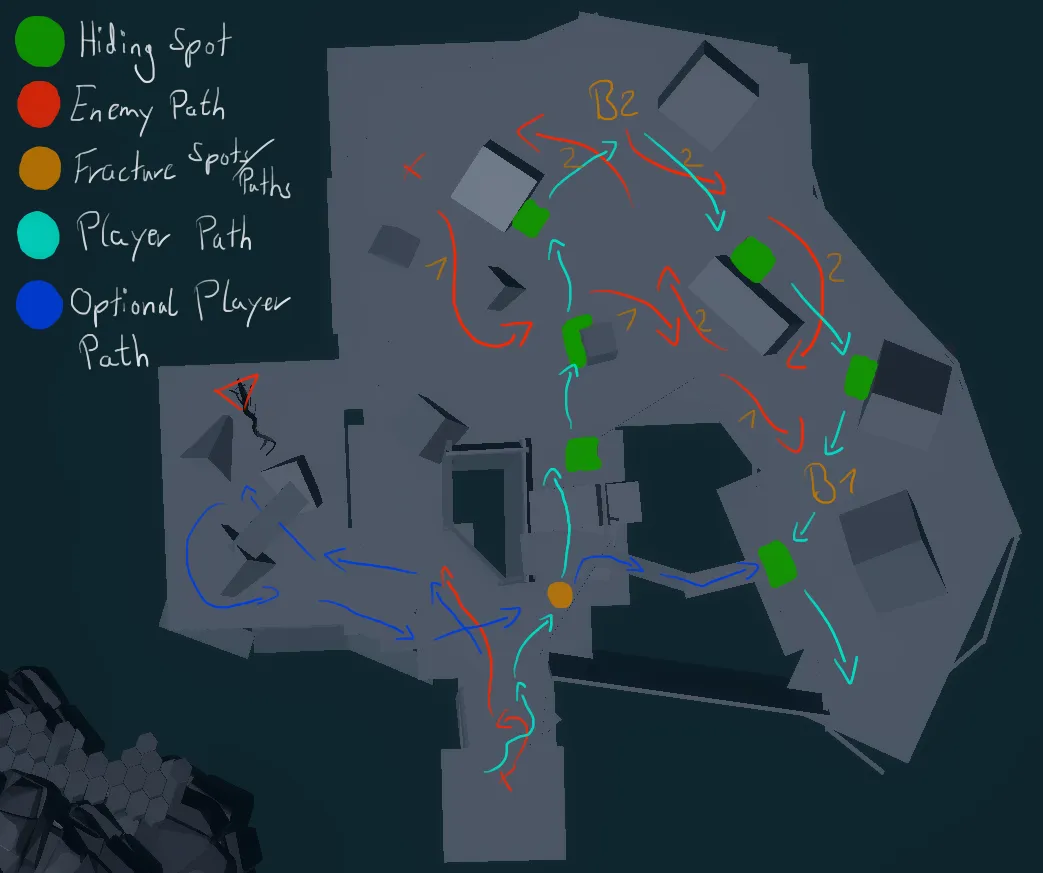
The player begins by watching the creature leave bubbles behind, reinforcing its movement and creating interest and foreshadowing.
After observing from above, the player descends into areas where the creature moves behind cover and then disappears, creating a safe moment for players to experiment with crouching and hiding.
The level features a large circular stealth zone, encouraging players to observe patrol patterns and move strategically using cover and timing.
From here,players can choose different paths: one that reintroduces contact with the creature, and another more risky but silent route, introducing a risk/reward design.
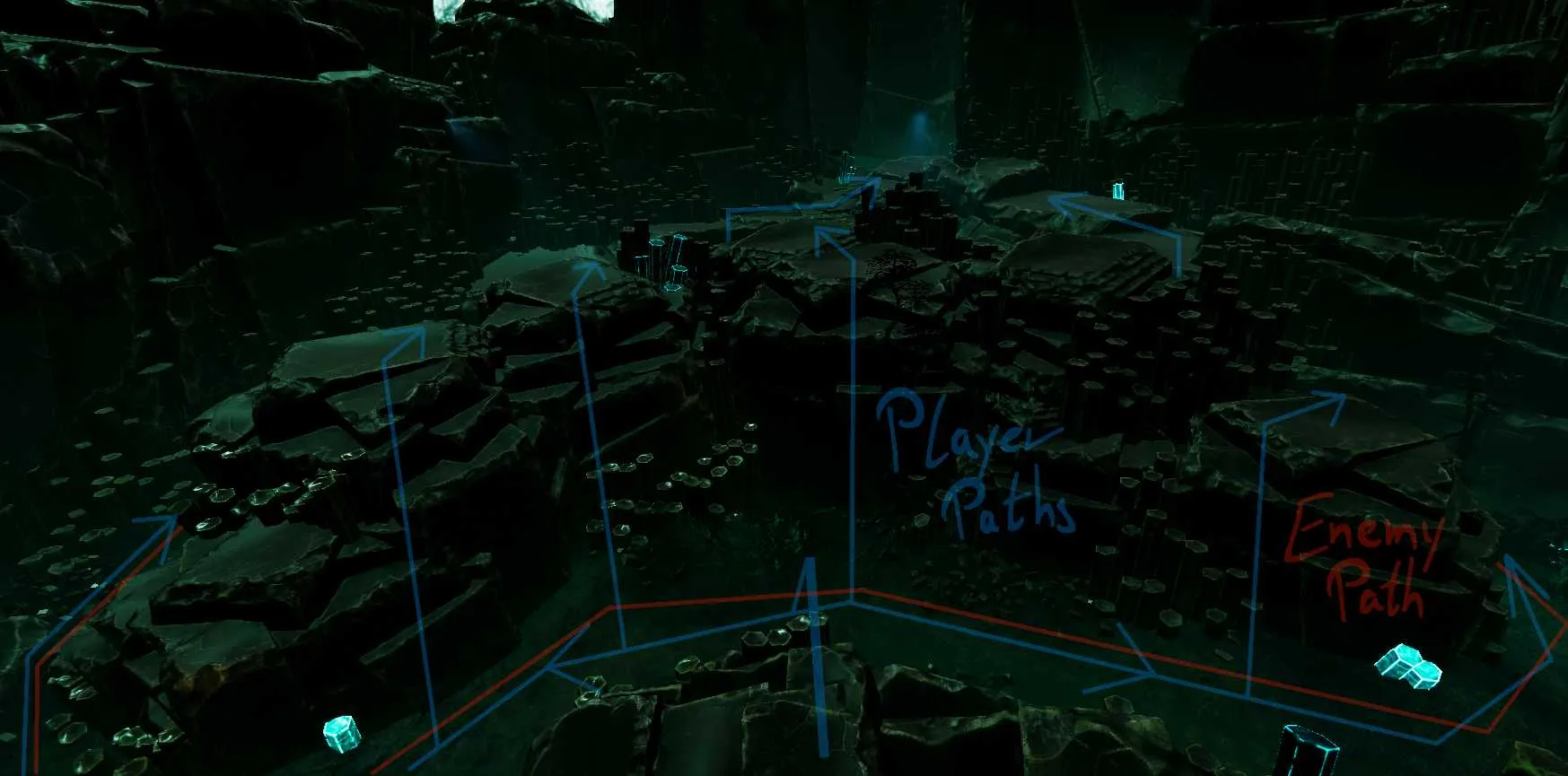
The level ends with a larger open area featuring gravity bubbles, allowing the player to reach new heights and tackle the space in multiple ways.
Level Goals & Design Psychology
The goal is to introduce core gameplay systems, stealth, creature observation,distraction, and bubble physics, progressively and safely.
The design uses emotional pacing: starting tense, moving into safe curiosity,then escalating into controlled tension. Players go from watching,to interacting, to mastering.
Directional flow (creature moving left to right) aligns with Western visual habits, guiding player movement intuitively.
Environmental cues (light,height, visual frames, shaders) are used to teach mechanics non-verbally,enhancing immersion.
The bubble mechanic is shown as playful and powerful, not only through its visual distinctiveness but also by how it alters player interaction with the terrain.
Level 4 - River
Gameplay Elements
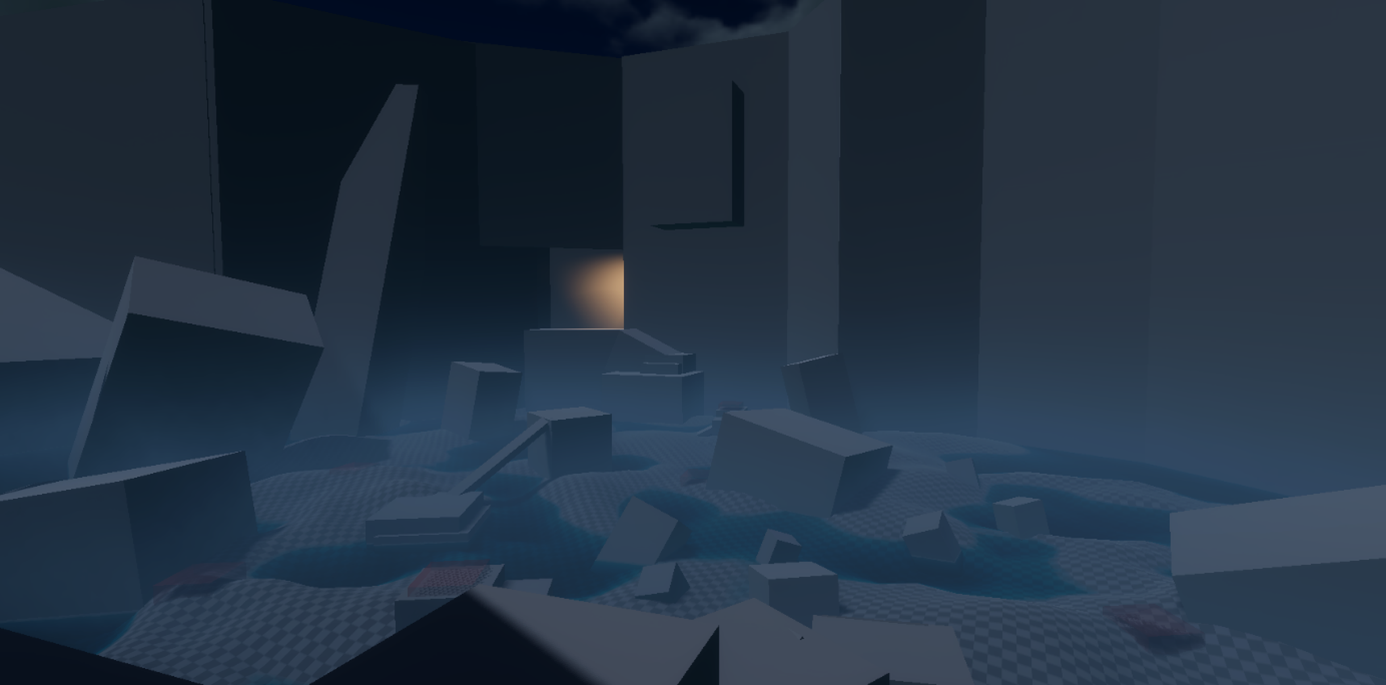
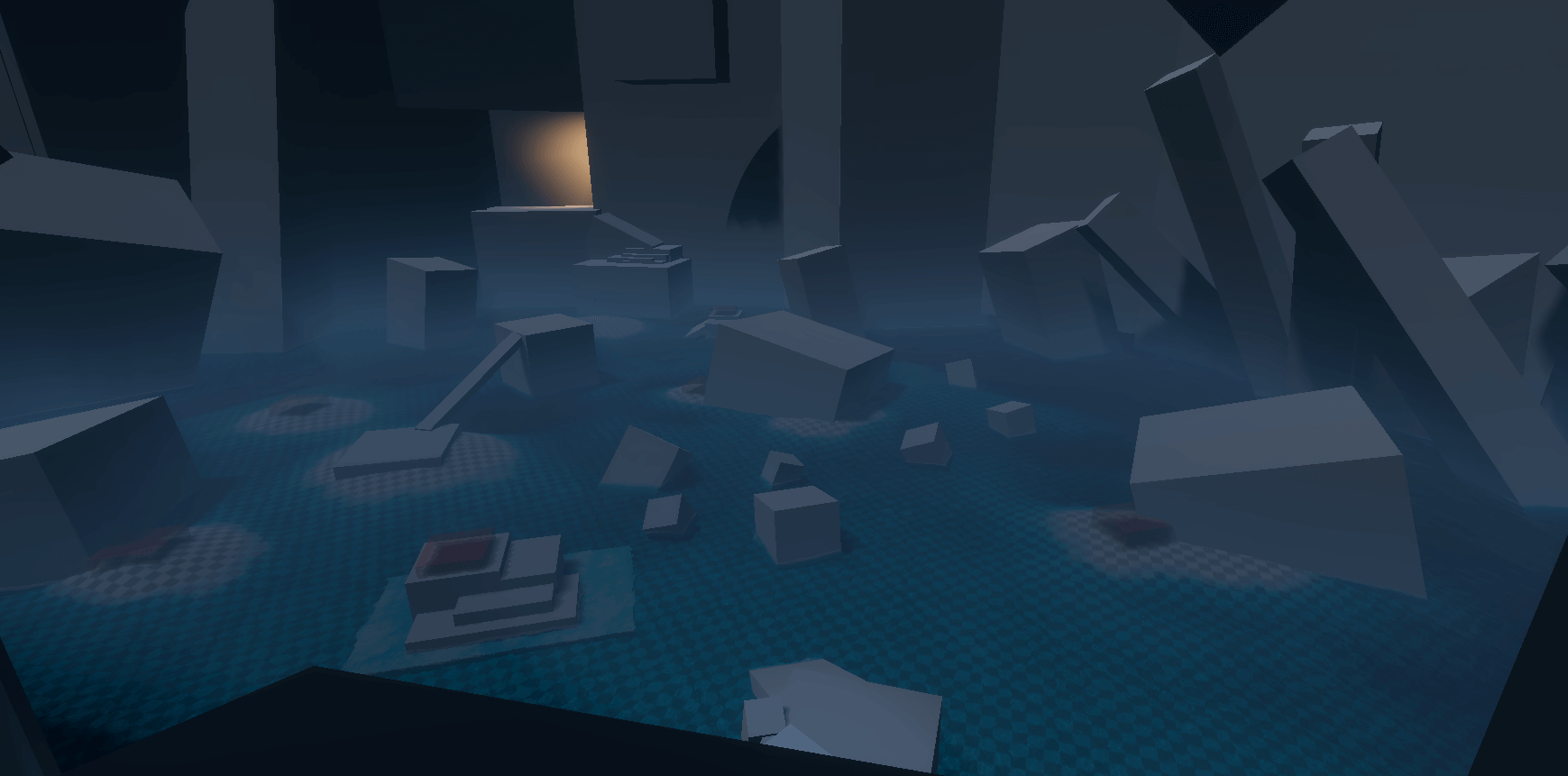
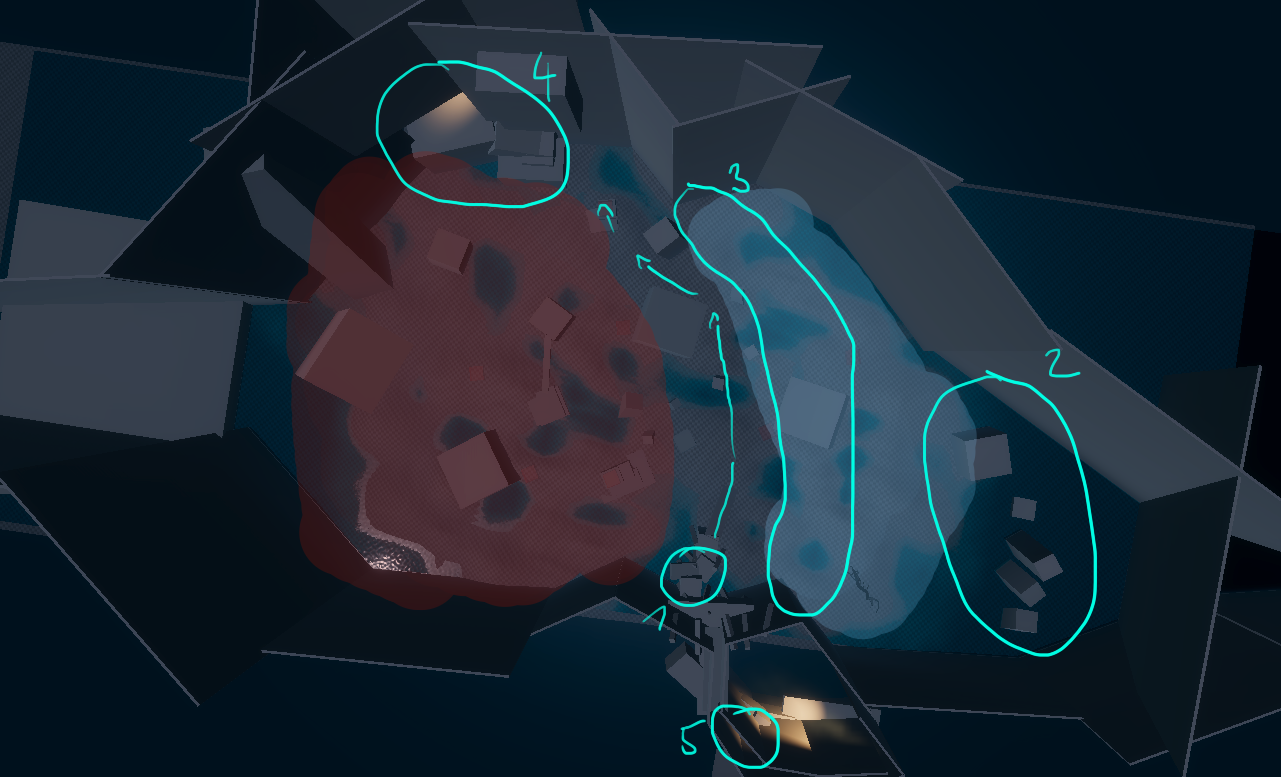
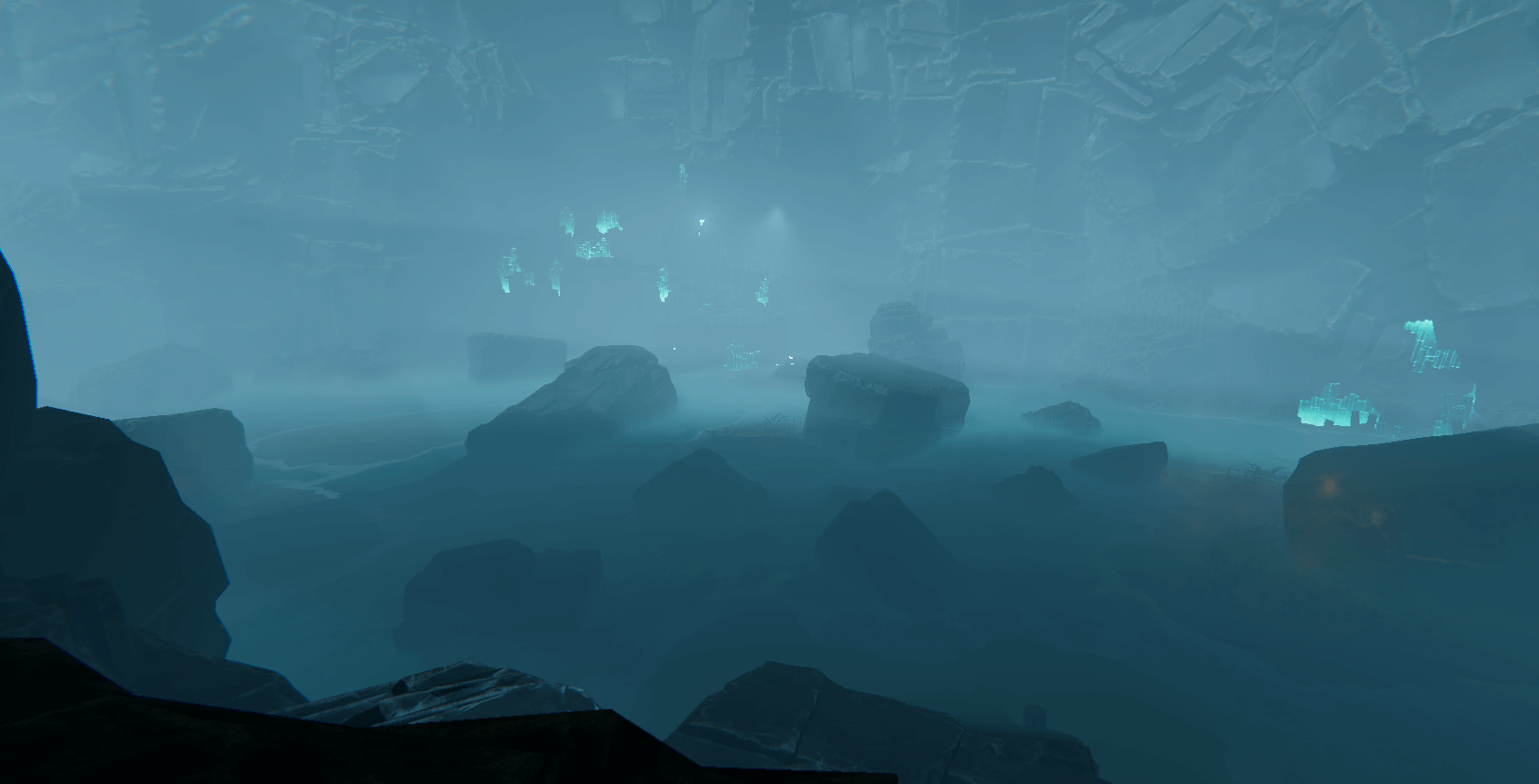
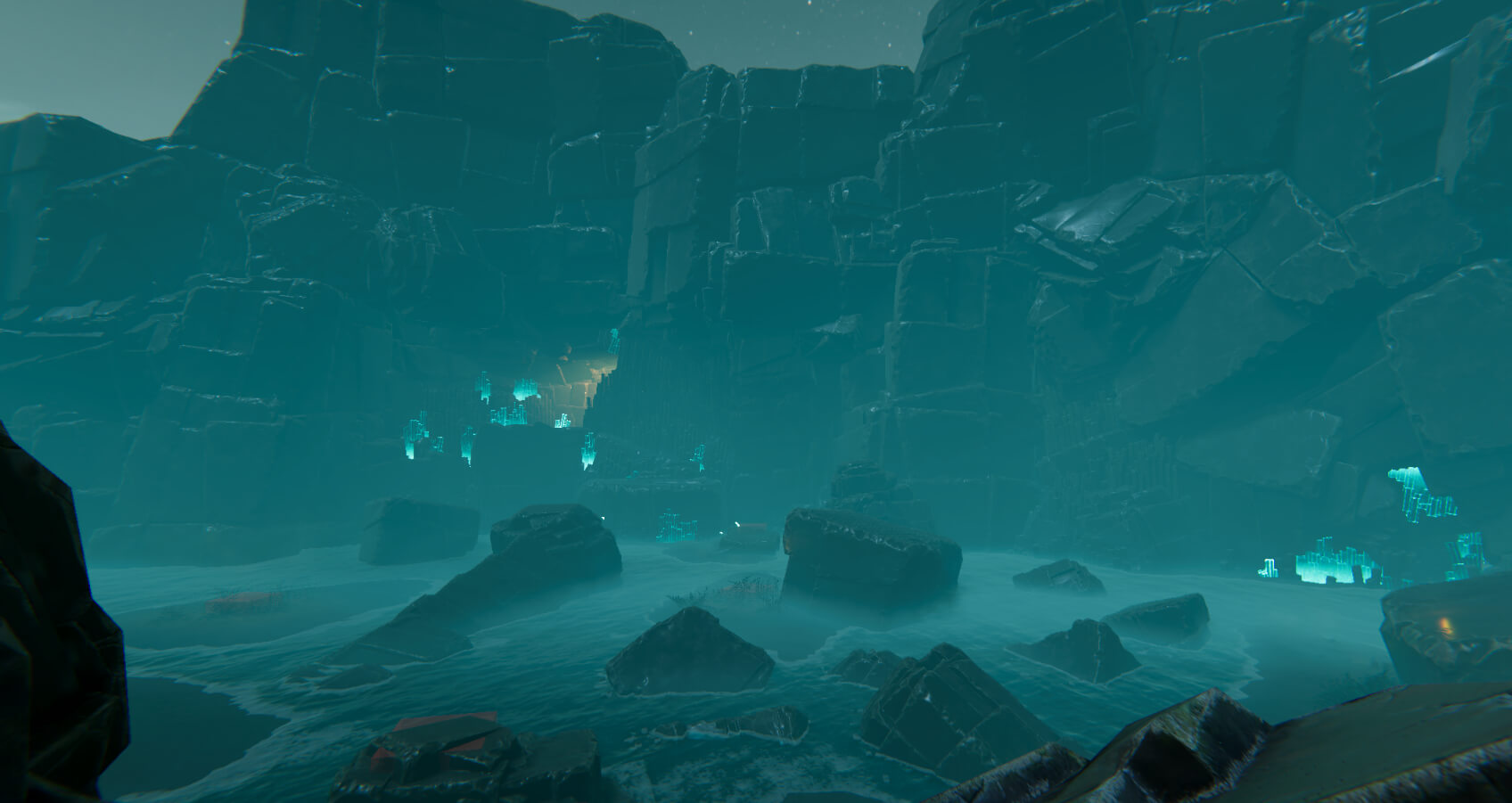
The river area introduces a new gameplay layer through tight corridors and open stealth navigation. It starts with a narrow, curved passage that climbs slightly upward, building anticipation and culminating in a moment of visual clarity, a design cue inspired by the “Breath of the Wild effect”, where a vast open space is revealed after a confined approach. The player stands atop a moving robot platform, emphasizing their position and line of sight across the area. The terrain is populated with rocks, elevated dirt patches, and bushes, which serve as cover points for stealth navigation. The creature patrols this layered environment, creating tension and encouraging the player to strategically move from bush to bush, using natural cover to stay hidden.
To reach the goal, highlighted in the distance by glowing lights and fireflies, players must traverse this open danger zone while managing visibility and timing. The finale of the river section introduces a vertical challenge. The player must bait the creature into using its gravity bubble ability near a steep cliff, allowing them to use altered gravity to ascend and reach the exit. This reinforces the bubble mechanic as a tool for traversal, not just a threat, and rewards players for creative interaction with enemy behaviors.
Level Flow
The area begins with a tight, twisting corridor, then expands into a layered river basin, offering both vertical and horizontal navigation. The creature's patrol paths are intentionally varied, creating distinct high-risk zones with faster movement and low-risk zones that offer safer,slower progression. This structure supports player agency, letting them choose between risk/reward tradeoffs. The flow pushes the player naturally from left to right, mirroring earlier directional patterns,while gradually escalating the tactical complexity of stealth and traversal.
Level Goals & Design Psychology
This segment is designed to teach the player to observe, plan, and execute under pressure in a semi-open environment. The player learns to read the creature's patrol logic, identify safe routes, and apply learned mechanics (like distraction and gravity manipulation) in more advanced contexts. The glowing endpoint offers a clear visual goal, keeping players oriented and motivated. The level balances freedom of movement with environmental storytelling, using natural cues like elevation, light, and patrol zones to guide progression without hand-holding.
Level 5 - Waterfalls
Gameplay Elements
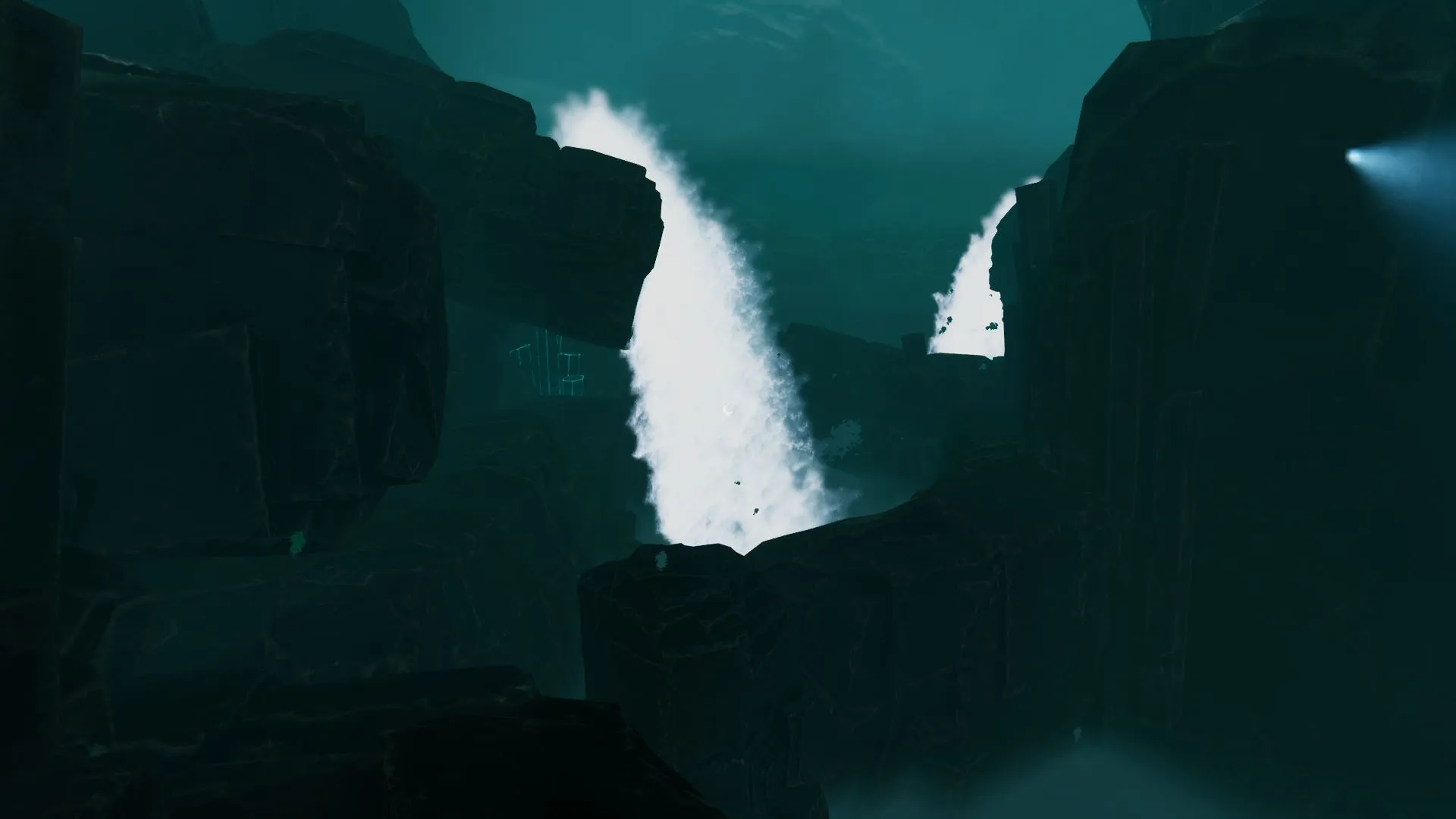
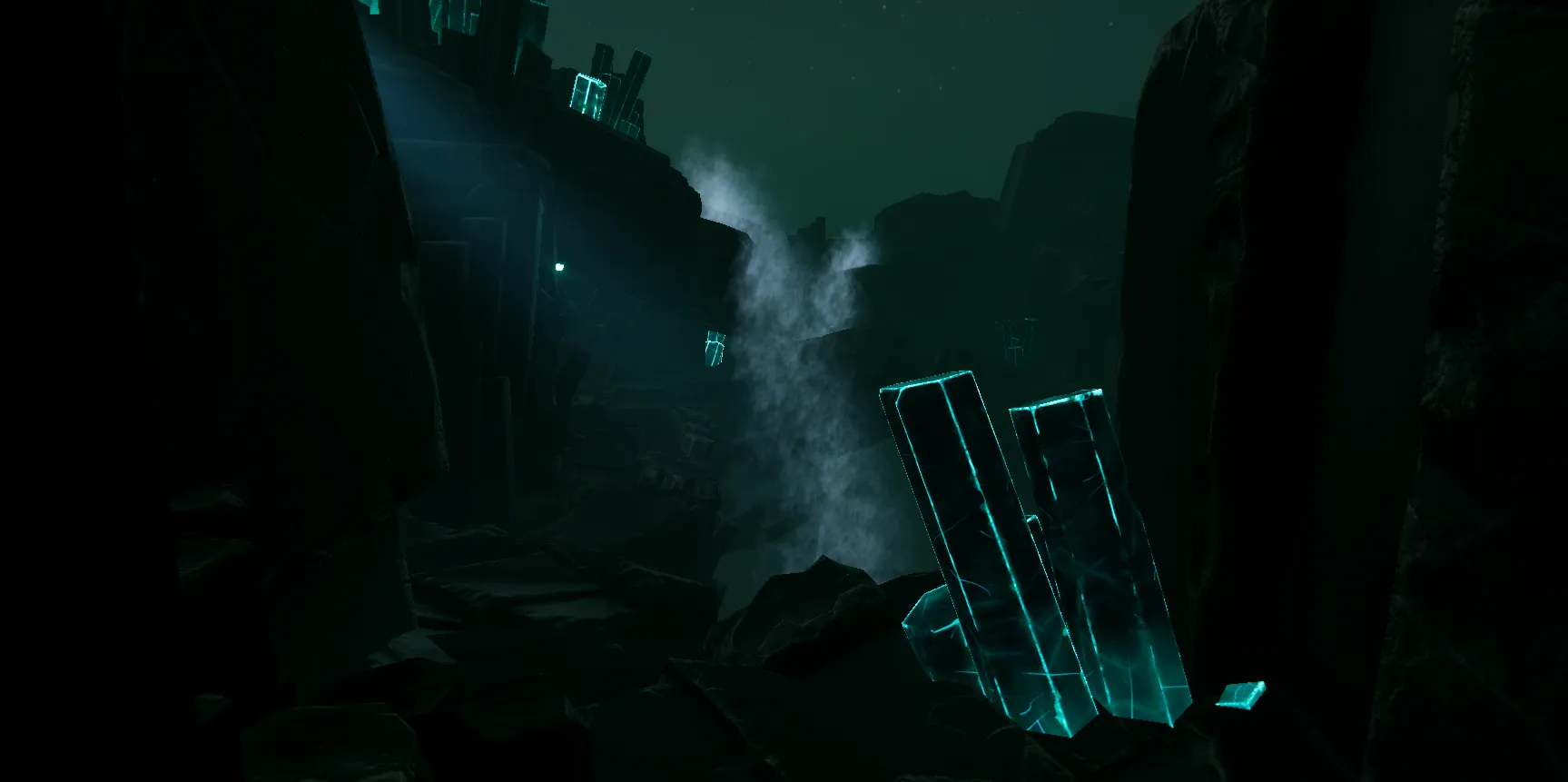
The waterfall section shifts the pacing by removing the creature threat, creating a calm, atmospheric moment focused on movement and environmental interaction. The player faces a massive drop with walls on either side, from which waterfalls cascade into an endless void. To progress, the player must carefully navigate narrow ledges along the walls without falling. This area emphasizes precision movement and introduces a choice between two distinct traversal styles: a high-risk,jump-heavy route, and a safer, crouch-based path that is slower but more secure. This continues the design theme of risk vs. reward and player-paced navigation.
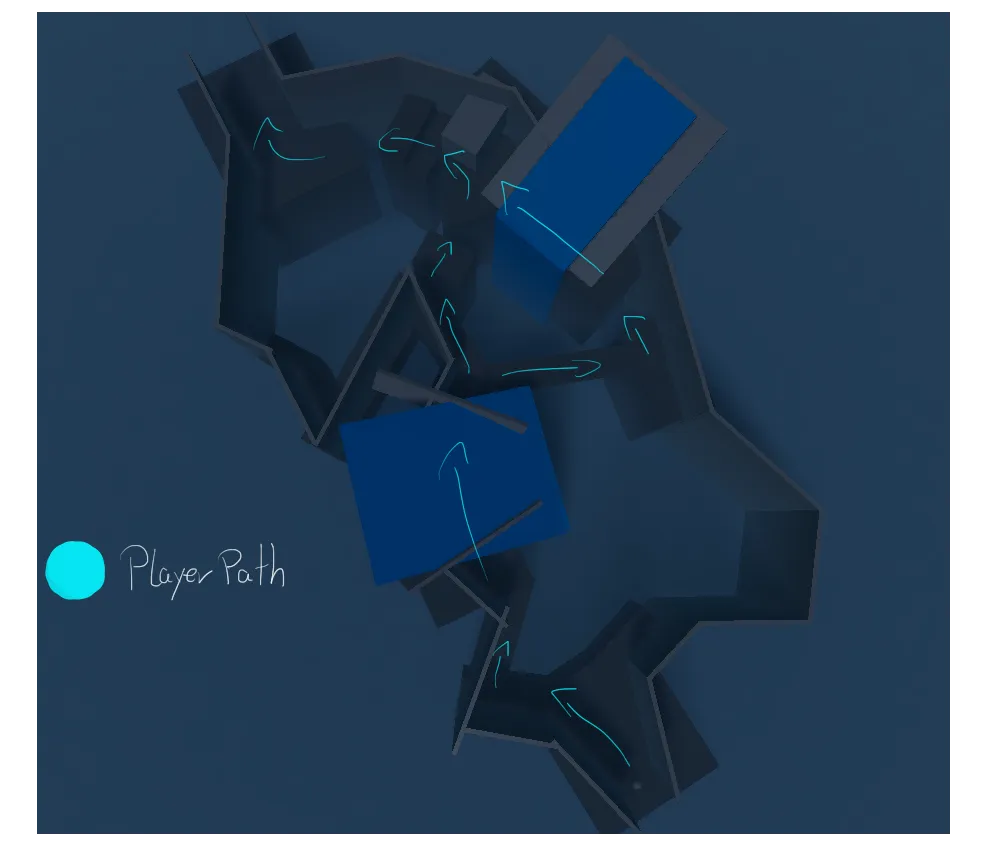
Level Flow & Atmosphere
This section is all about mood, immersion, and pacing. It offers a moment of calm between stealth-heavy encounters, allowing the player to reflect and breathe. The 3D sound design plays a vital role, the closer the player gets to the waterfalls, the louder they become, and moving behind them triggers a surrounding, immersive audio effect. These soundscapes enhance the emotional weight of the environment, making the space feel alive and powerful, despite the absence of enemies.
Level Goals & Design Psychology
The waterfall area is designed as a moment of release and reflection, giving players time to internalize previous mechanics (like parkour, jumping,and crouching) in a non-threatening space. It also introduces visual and auditory tension through its verticality and soundscape, keeping players alert despite the absence of immediate danger. By offering two paths, fast and risky or slow and safe, the game encourages players to express their preferred playstyle, reinforcing a sense of agency and mastery.
Level 6 - The Wall
Gameplay Elements
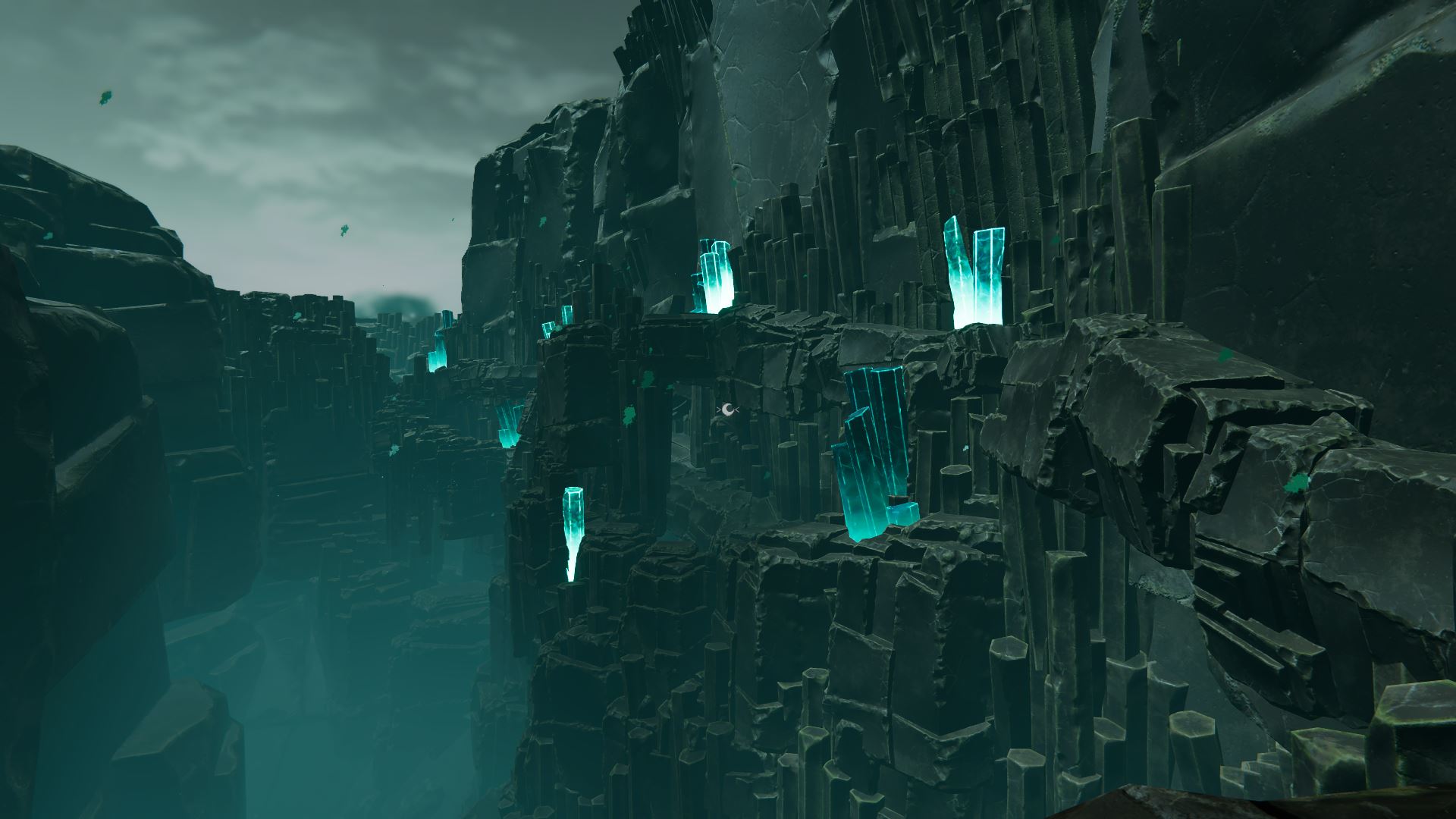
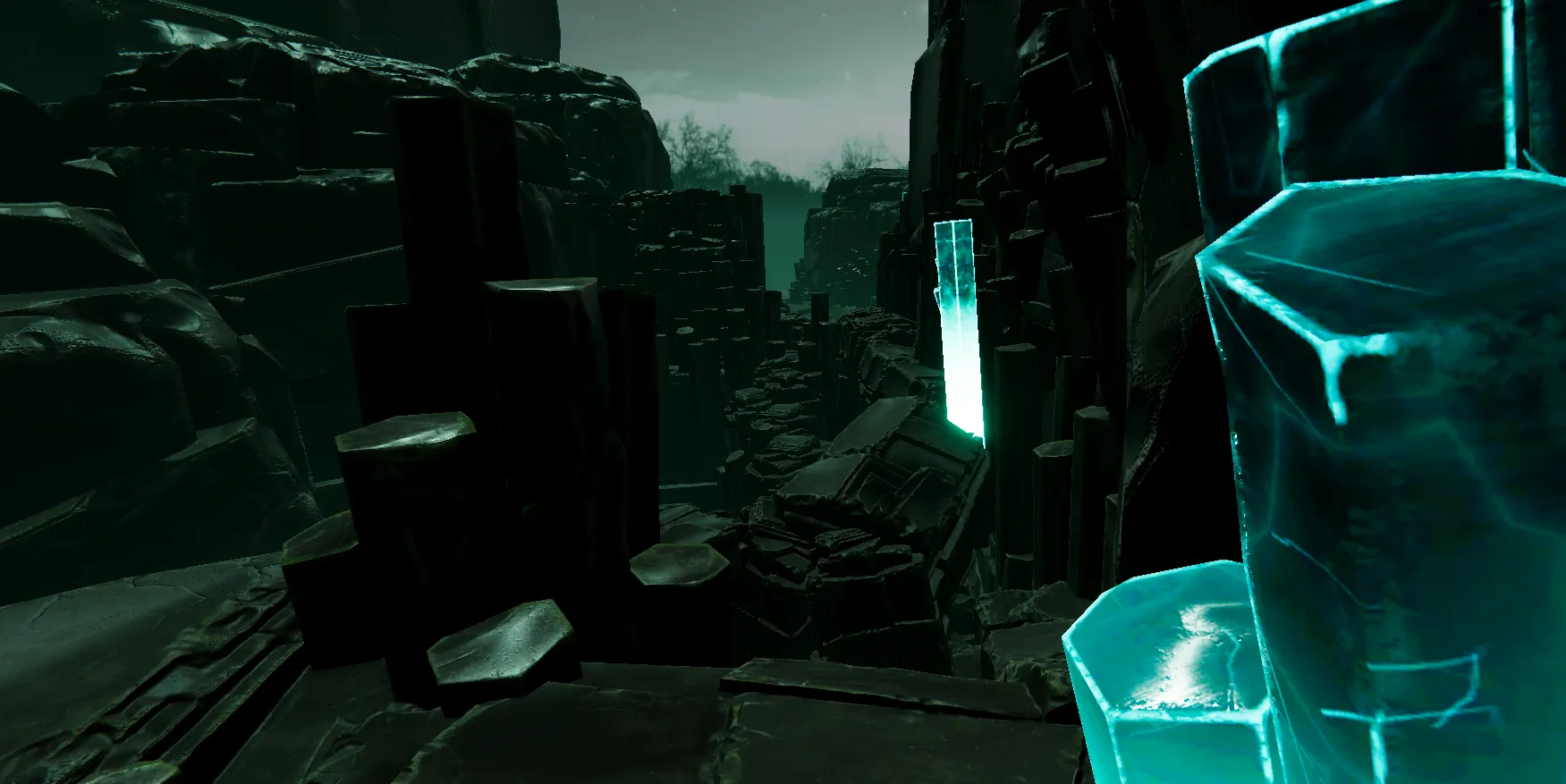
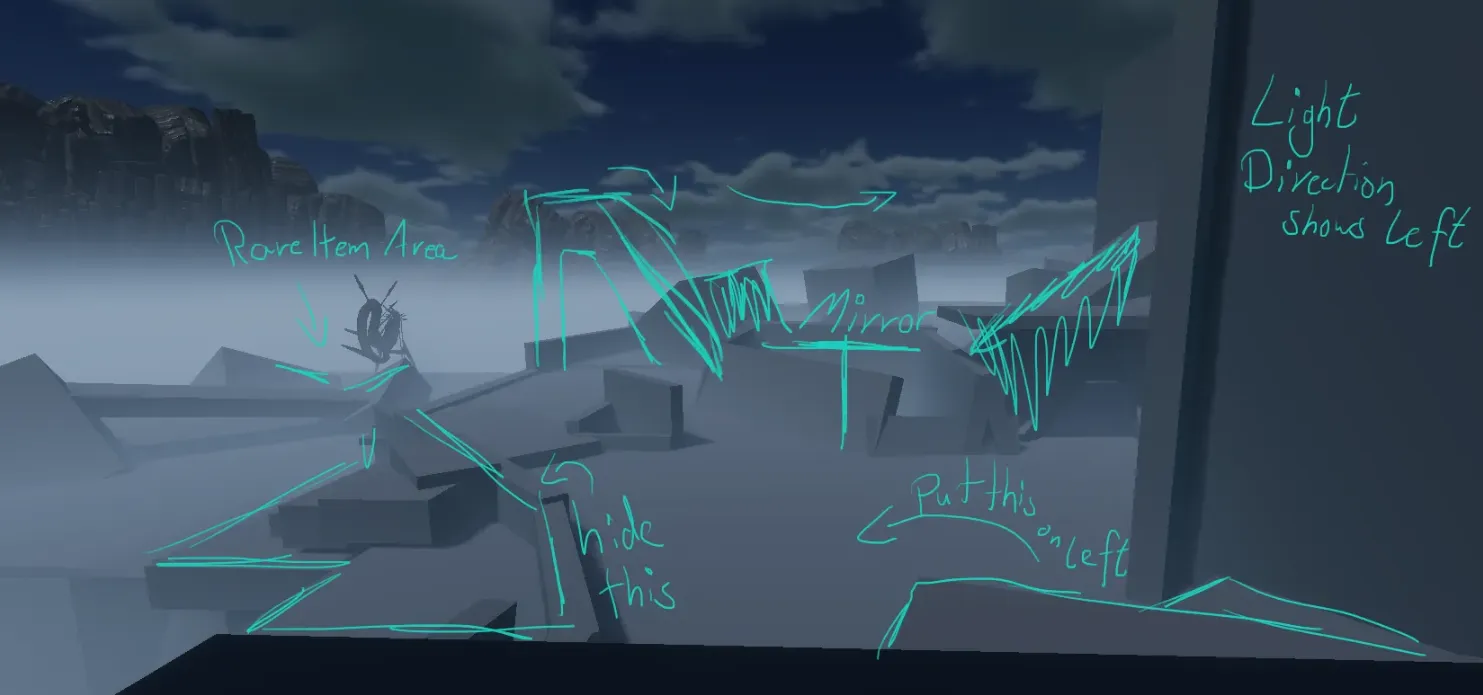
The Wall section serves as the final preparation zone before the climactic encounter with the creature, designed to rebuild tension through intense platforming rather than direct threat. Although the creature is absent,the challenge comes from the environment itself. The player must traverse a narrow ledge with a deadly drop to the left, emphasizing precision and focus. The wall stretches in a wide curve from right to left, making the goal and direction clearly visible and naturally guiding the player forward.
The level presents multiple traversal paths, including jump-based parkour routes and ducking passages, reinforcing previously learned mechanics. These paths vary in verticality, creating a sense of dynamism, higher paths intersect and shift into lower ones and vice versa, offering moments of visual complexity and reorientation despite the environment being completely static.
Level Flow & Design Psychology
This section is all about heightened anticipation and mechanical mastery.It’s carefully constructed to test the player’s confidence in movement,especially under pressure. The use of curved, narrow geometry subtly increases tension by forcing careful movement while providing clear line of sight to the endpoint. The alternating vertical paths not only add replayability but also train the player's adaptability, preparing them for the unpredictability of the final confrontation. By gradually building difficulty without an immediate enemy threat, the Wall area maintains psychological pressure while allowing space for mechanical refinement.
Level 7 - Final Level
Gameplay Elements
The final area is where all core mechanics, from platforming to stealth and strategic thinking, culminate. The player traverses a high vantage point above the familiar river, reintroducing a previously visited space to establish narrative and spatial continuity. Here, the creature reappears, leaving behind either a gravity bubble or bridge bubble,which skilled players can use to gain a tactical advantage. If the player fails, they fall safely into the river and can continue,ensuring that less experienced players are not punished.
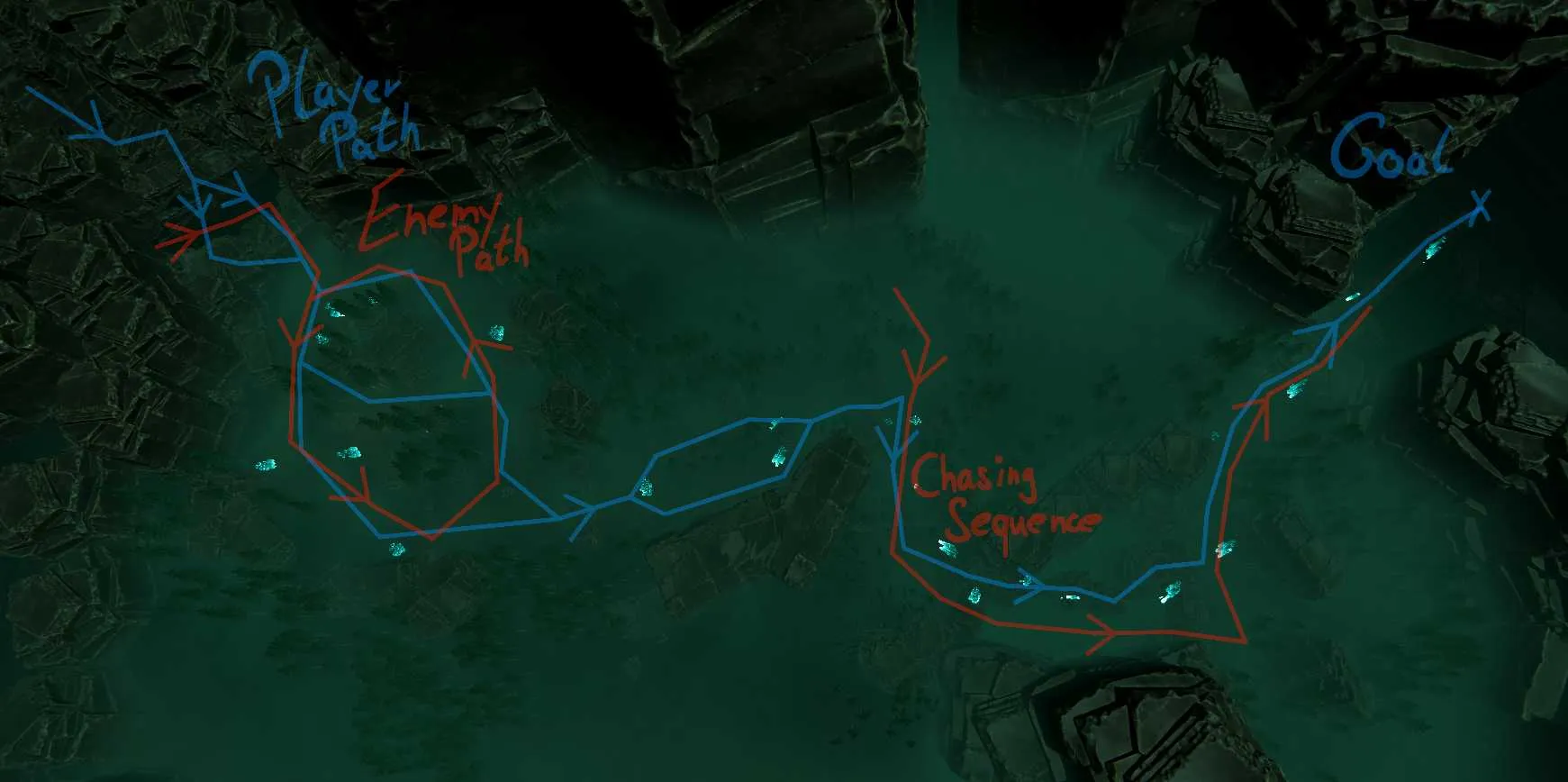
Afterward,the player enters a stealth sequence with tight patrol routes,requiring careful use of bushes and rocks as hiding spots. This is followed by a slower-paced moment to prepare for the final chase,maintaining a deliberate tension curve:
Reveal → Danger → High Intensity → Calm → Climax.
Level Flow & Narrative Integration
The level then funnels the player left, toward a branching path. If the player follows the obvious route, the creature jumps out,initiating a high-stakes chase. In that moment of panic, the player must quickly turn 180° to find a previously unseen escape route. This chase demands mastery of platforming mechanics as the player climbs a rock wall while being pursued.
Midway, the creature overtakes the player, forcing a reroute to the left and into a steep, narrowing slope. As the player ascends, the lighting and sound design shift—they begin to hear a waterfall and see thesun rising, signaling a transition from the spirit world back to the real world. The path ends with a cinematic leap into a lake, where the camera takes control, revealing the village from the start of the game and concluding with sunrise.
Level Goals & Design Psychology
This final sequence ties together emotional closure and mechanical mastery.The level design ensures that player skill is rewarded, while still being accessible through fail-safe systems. The looping back to familiar locations, coupled with a changing skybox and time-of-day shift, reinforces the narrative of a spiritual journey. The final jump into the lake acts as a symbolic rebirth, completing the player's transition from the spirit realm back to the real world, bringing the game to a satisfying and cinematic close.
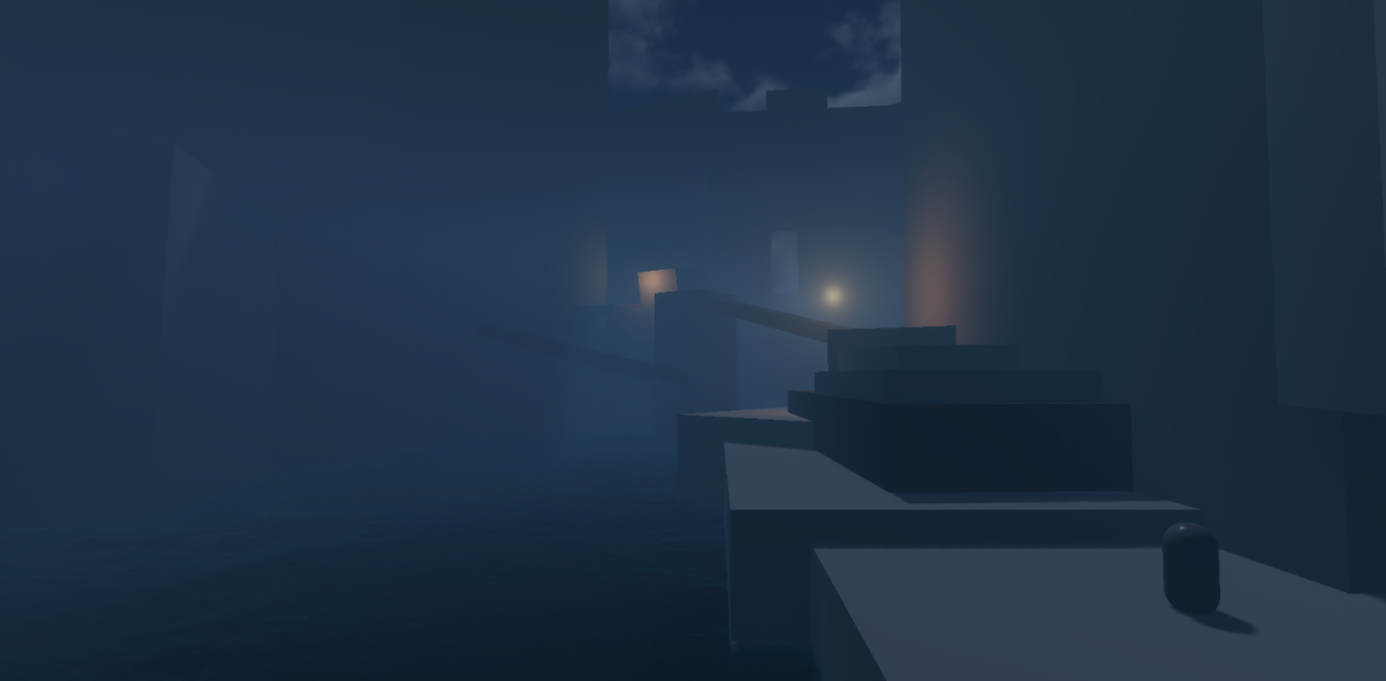
Blockouts that didn't make it into the final project
Read More about Solstice
Other Projects
Type: Echolocation Bat Exploration
Genre: Stealth Game
My Tasks: Level Design, Game Design, Project Management
Type: Fractures in Reality
Genre: Stealth/Exploration
My Tasks: Level Design, Game Design, Project Management, Programming
Type: Bachelor Solo Project
Genre: Adaptive Free-Runner
My Tasks: Level Design, Programming, Game Design, Project Management
Type: Design Studies, Prototypes, Modding, ...
Genre: Dungeons, RPGs, Jump'n'Run, ...
My Tasks: Solo Side Projects